
Hydraulic oil coolers
Fan driven oil-air coolers (12 V, 24 V and 220 V), oil-water heat exchangers and temperature control components: components that keep overheating oil at working temperature.
Hot oil thins out, internal leakage increases, seals harden and the oil oxidizes. Overheating is the hidden start of most hydraulic failures. When we design our hydraulic power units, we calculate the heat load and size the cooler from the outset. On existing units that run hot, we first find the source of the heat and then add cooling. We ship fan driven coolers for mobile equipment and fixed installations from stock to every part of Türkiye and abroad, and also sell them through our online store (Turkish) at hidroticaret.com.
Types
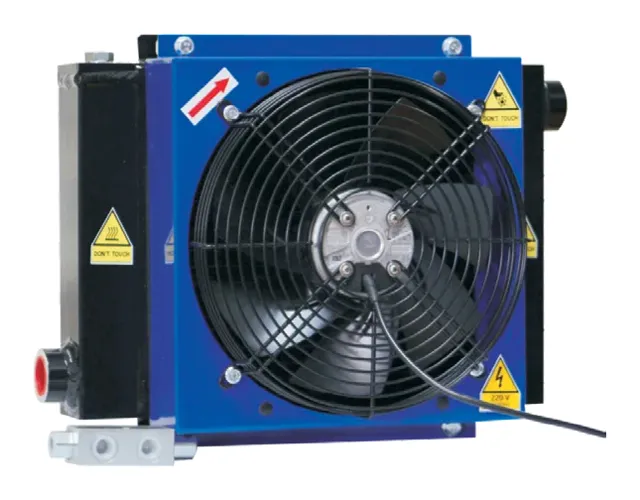
AC fan oil-air coolers
Coolers with a fan supplied from the mains (220 V). Used on power units in fixed installations.
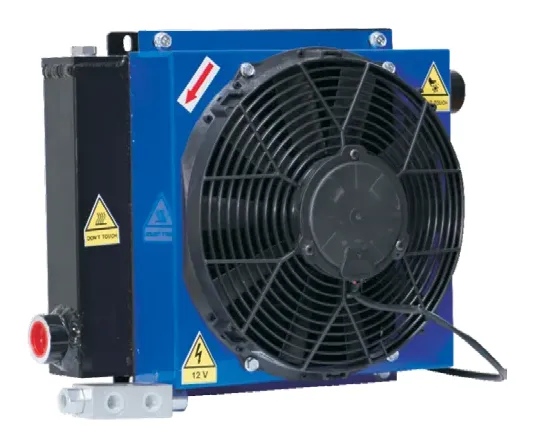
DC fan oil-air coolers
Coolers with a 12 V or 24 V fan. On construction machinery, truck mounted equipment and mobile hydraulics they run on the vehicle's own electrical system.
Oil-water heat exchangers
They transfer the heat to cooling water. Used with high heat loads, in dusty or hot environments and where fan noise is not wanted.
Temperature control and bypass components
A thermostat runs the fan only when needed. A bypass check valve stops thick oil from straining the cooler core during a cold start.
Product images: hidroticaret.com and manufacturers.
How to select
The need for a cooler starts from the heat load. Part of the power supplied to the pump leaves the system as heat, not as work: oil returning under pressure through throttle and relief valves, internal leakage in the pump and friction in the lines. The table below estimates this loss with a common design rule of thumb. The exact calculation is made from the cycle time and the circuit.
The practical threshold is about 60 °C: if the oil runs above this continuously, the system needs a cooler. Three values are considered when selecting a cooler: the flow through the cooler, the heat to be dissipated and the fan voltage. A 12 or 24 V fan is chosen for mobile applications and a 220 V fan for fixed installations.
The cooler is usually connected into the return line, just before the oil enters the tank. Because the cooler core is not built for full system pressure, it is not connected into the pressure line. During a cold start, thick oil strains the core, so it is good practice to fit a bypass check valve in parallel.
Before adding a cooler, the cause of the heat should be examined. Oil returning to tank under pressure through the relief valve unnecessarily, a directional valve with an unsuitable center position or a worn pump are causes that a cooler will hide but not solve.
Estimated heat load by motor power
| Motor power of the unit | Heat to be dissipated (estimated) |
|---|---|
| 2.2 kW | 0.4-0.7 kW |
| 4 kW | 0.8-1.2 kW |
| 7.5 kW | 1.5-2.2 kW |
| 11 kW | 2.2-3.3 kW |
| 15 kW | 3.0-4.5 kW |
| 22 kW | 4.4-6.6 kW |
Common design rule of thumb: 20-30% of the input power turns into heat. This is not a standard, it is a starting value. The tank and pipe surfaces dissipate part of the heat by themselves, and the cooler is sized for the remainder. In circuits that throttle continuously or hold at high pressure the proportion is higher.
Frequently asked questions
Does my hydraulic system need an oil cooler?
Yes, if the oil temperature stays above about 60 °C continuously. The temperature should be measured first, and it should be checked whether the heat comes from an unnecessary loss.
How do I size a hydraulic oil cooler?
By the heat to be dissipated and the flow through the cooler. The heat load is estimated from the motor power, the cycle time and the losses in the circuit.
What is the difference between 12 V, 24 V and 220 V coolers?
Only the fan supply. The 12 and 24 V models run on the vehicle's electrical system on vehicles and construction machinery, and the 220 V models run on mains power in fixed installations.
Where is a hydraulic oil cooler installed?
Usually in the return line, before the oil enters the tank. Because the core is not built to withstand line pressure, it is not connected into the pressure line.
I have a cooler but the oil still overheats. Why?
The core may be clogged with dust, the fan may be running backwards, or the cooler may be too small for the heat load. The source of the heat should also be checked: oil flowing continuously over the relief valve is the most common cause.
Can you add a cooler to my existing power unit?
Yes. We determine the heat load and the return flow and add a suitable cooler to the circuit, with a thermostat and bypass valve if required.
Stock, sizes and part numbers
Sizes in stock, manufacturer part numbers and brands are kept up to date in our catalog. Send us your requirement on WhatsApp or by e-mail and we will quote and ship worldwide.
Hydraulic oil coolers in the catalog Online store (Turkish) →