
Rotary shaft seals and V-rings
Radial shaft seals (oil seals) and V-rings: sealing of the rotating shaft in pumps, gearboxes and motors.
Sealing a rotating shaft is a different problem from sealing a cylinder: the seal rubs continuously at the same point and heats up. In pump, gearbox and hydraulic motor maintenance we also handle rotary shaft seals and find the right seal from the shaft and housing dimensions.
Types
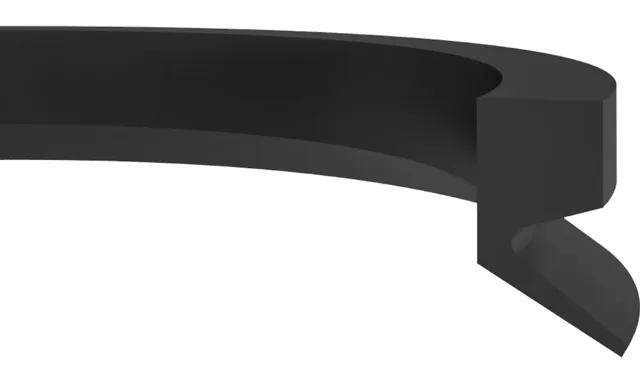
V-rings
Axial seals that are fitted on the shaft and rotate with it; protection against dust and water.
Radial shaft seals
Seals with a spring-loaded sealing lip; they keep the oil inside.
Types with a dust lip
A second lip keeps out dust and water coming from outside.
Product images: Kastaş.
How to select
A radial shaft seal is defined by shaft diameter × housing bore diameter × width. The lip is pressed onto the shaft by the spring and keeps the oil inside; it must be fitted with the lip facing the oil side. Standard seals are for unpressurized or very low pressure bearing housings; pressurized applications need special pressure-resistant types.
The shaft surface determines the life of the seal: on a shaft that is worn and grooved at the point where the seal runs, a new seal will also leak in a short time. In that case the running position of the seal is shifted or the shaft surface is restored.
In pump and hydraulic motor seal kits the rotary shaft seal is part of the kit; replacing the whole kit instead of individual seals prevents the other elements of the same age from leaking shortly afterwards.
The material is selected according to the operating conditions: NBR is used for general-purpose applications, FKM at high temperature and high surface speed.
Surface speed at the seal lip by shaft diameter and rotational speed
| Shaft diameter | 1000 rpm | 1500 rpm | 3000 rpm |
|---|---|---|---|
| Ø20 mm | 1.0 m/s | 1.6 m/s | 3.1 m/s |
| Ø30 mm | 1.6 m/s | 2.4 m/s | 4.7 m/s |
| Ø40 mm | 2.1 m/s | 3.1 m/s | 6.3 m/s |
| Ø50 mm | 2.6 m/s | 3.9 m/s | 7.9 m/s |
| Ø60 mm | 3.1 m/s | 4.7 m/s | 9.4 m/s |
| Ø80 mm | 4.2 m/s | 6.3 m/s | 12.6 m/s |
| Ø100 mm | 5.2 m/s | 7.9 m/s | 15.7 m/s |
Calculation: surface speed = π × shaft diameter × rotational speed ÷ 60,000. The seal material is selected according to this speed; as speed rises, frictional heat increases and FKM is needed instead of NBR. The limit allowed by the material is checked in the manufacturer's catalog for the profile.
Frequently asked questions
Which way does a shaft seal go in?
It is fitted with the spring-loaded sealing lip facing the fluid being retained, that is, the oil side.
Can a standard shaft seal withstand pressure?
Standard seals are for unpressurized or very low pressure applications; where there is pressure, a pressure-resistant type must be selected.
What is a V-ring used for?
It is an axial seal that rotates on the shaft; it provides dust and water protection in front of bearings and seals.
What is the difference between a radial shaft seal and a V-ring?
A radial seal sits in the housing and presses on the shaft with its lip; it keeps the oil inside. A V-ring rotates with the shaft and presses against a face to keep dirt and water out; it is often used in front of the radial seal as additional protection.
Why does my shaft seal leak even though it is seated correctly?
A wear track may have formed on the shaft, the shaft may have runout, or the seal material may not suit the surface speed and temperature. The shaft needs to be checked before the seal is replaced.
Which dimensions do I need to give for a shaft seal?
Shaft diameter, housing bore diameter and seal width; if possible, the old seal itself or a photo of it. If you also state the speed and operating temperature, we select the material accordingly.
Stock, sizes and part numbers
Sizes in stock, manufacturer part numbers and brands are kept up to date in our catalog. Send us your requirement on WhatsApp or by e-mail and we will quote and ship worldwide.
Rotary shaft seals and V-rings in the catalog Online store (Turkish) →