
O-rings and static seals
O-rings in metric and inch sizes, back-up rings and bonded seals: static sealing for covers, flanges, fittings and valve blocks.
The O-ring is the simplest but most widely used sealing element; if it is not selected with the right material and size, it can stop even the most expensive machine. As an authorized Kastaş dealer we supply O-rings and sealing washers from stock and help select the material that suits the fluid and temperature.
Types
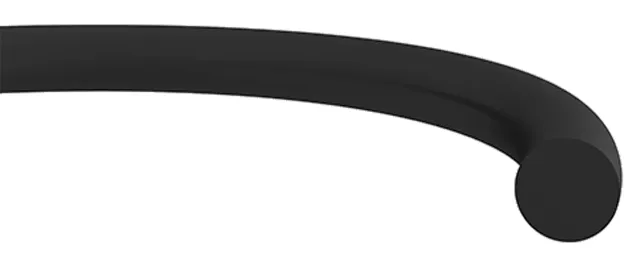
O-rings
Defined by inner diameter × cross-section; static sealing and low-speed dynamic sealing.
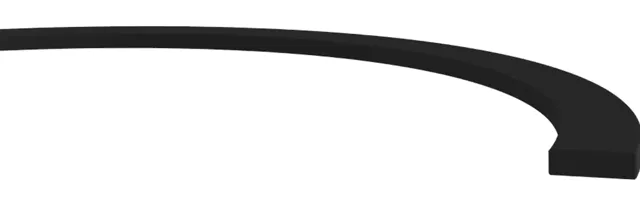
Back-up rings
Prevent the O-ring from extruding into the gap at high pressure.
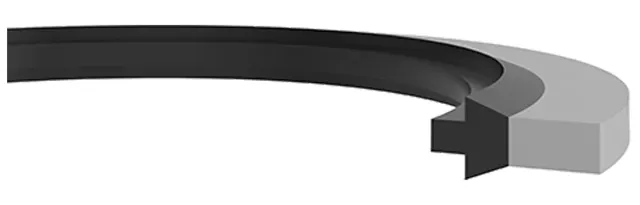
Bonded seals and sealing washers
Metal-rubber bonded washers and sealing rings; sealing under fittings and plugs.
Product images: Kastaş.
How to select
An O-ring is defined by two dimensions: inner diameter and cross-section (cord) thickness. When fitted in the groove it is squeezed by a set ratio to create the seal; if the cross-section is too large for the groove it overfills the groove and is cut, and if it is too small it leaks.
The material is selected according to the fluid and temperature; the wrong material swells, hardens or cracks. NBR is the standard in mineral oil hydraulics; FKM is used at high temperature and EPDM in water and steam, but EPDM does not resist mineral oil. The table shows the approximate limits of the main materials.
At high pressure an O-ring can be pushed into the gap between the parts and cut; in that case a harder material (90 Shore A) or a back-up ring is used. If the size of an O-ring is unknown, we find the equivalent by measuring it with a caliper or by working it out from the groove dimensions.
The material is selected according to the fluid and temperature: NBR, FKM, EPDM, HNBR and silicone. For hardness, 70 and 90 Shore A are generally used; the harder one is preferred at high pressure and where the gap is large.
Seal materials and approximate operating temperatures
| Material | Abbreviation | Approximate temperature range | Where it is used |
|---|---|---|---|
| Nitrile rubber | NBR | -30 … +100 °C | Mineral oil and grease; general-purpose standard |
| Polyurethane | PU (AU) | -30 … +100 °C | Wear and high pressure; hydraulic rod and piston seals |
| Fluoroelastomer (Viton) | FKM | -20 … +200 °C | High temperature and chemicals |
| Hydrogenated nitrile | HNBR | -30 … +150 °C | Oil at high temperature; mobile hydraulics |
| Ethylene propylene | EPDM | -45 … +150 °C | Water, steam, brake fluid; NOT SUITABLE for mineral oil |
| Silicone | VMQ | -60 … +200 °C | Food contact and wide temperature range; low wear resistance |
| PTFE (bronze or carbon filled) | PTFE | -100 … +200 °C | Low friction; guide rings and slide seals |
The values are the typical range of the material family; the exact limit depends on the profile, the fluid and the manufacturer. The material is always evaluated together with the fluid.
Frequently asked questions
How do I read an O-ring size?
It is read as inner diameter × cross-section thickness; for example, 40 × 3 is an O-ring with an inner diameter of 40 mm and a cross-section of 3 mm.
NBR or Viton (FKM) O-ring?
NBR is sufficient for mineral oil at normal temperature. FKM is preferred for high temperature and chemical environments.
Can EPDM O-rings be used with hydraulic oil?
No. EPDM performs well in water and steam, but in mineral oil it swells and deteriorates.
When is a back-up ring needed?
At high pressure and where the gap between the parts is large, to prevent the O-ring from extruding into the gap.
Can you find an O-ring if I do not know its size?
Yes. Sending the O-ring or the groove dimensions is enough; we identify the size and material and supply the equivalent.
Stock, sizes and part numbers
Sizes in stock, manufacturer part numbers and brands are kept up to date in our catalog. Send us your requirement on WhatsApp or by e-mail and we will quote and ship worldwide.
O-rings and static seals in the catalog Online store (Turkish) →