
Pneumatic cylinders
Every component that turns compressed air into motion: standard, round body and compact cylinders, guided and rodless cylinders, rotary actuators and grippers.
We are a Pemaks distributor: we ship pneumatic cylinders from stock anywhere in Türkiye and abroad, and also sell them through our online store hidroticaret.com (Turkish). We select a cylinder together with the circuit it will work in, not on its own: we look at the load, stroke, cycle rate and environment as a whole and, where needed, prepare the valve, air preparation and fittings in the same package.
Types
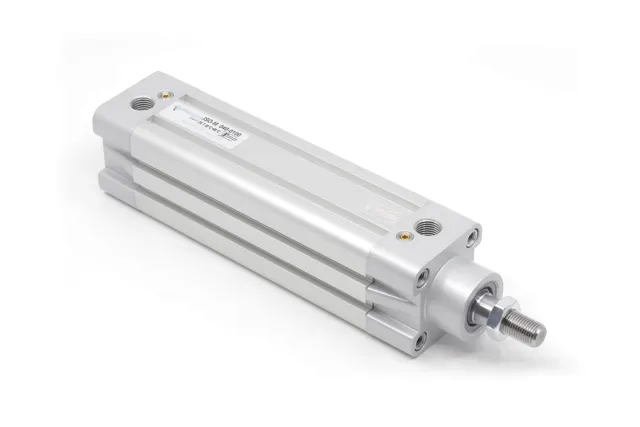
Standard cylinders (ISO 15552)
Profile body cylinders from Ø32 upwards. Because the mounting dimensions are standardized they are interchangeable from brand to brand. The most common type in industry.
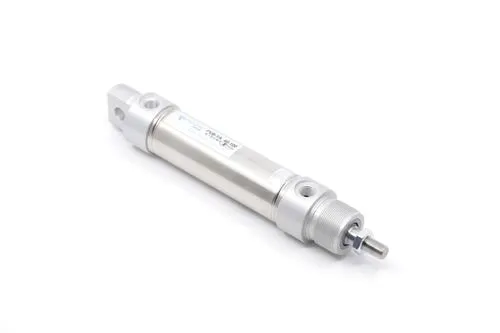
Round body cylinders (ISO 6432)
Small bore Ø8-25, light and economical cylinders for low-force pushing and positioning tasks.
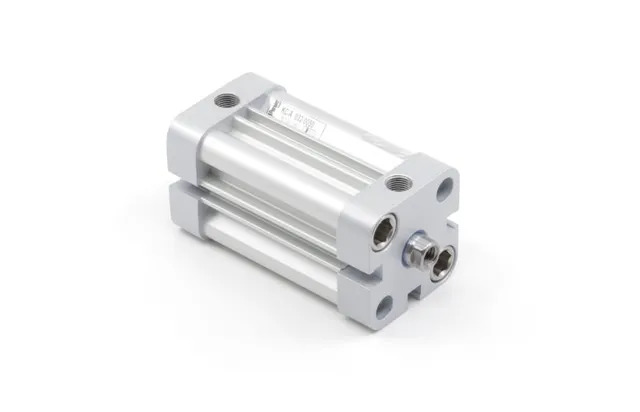
Compact cylinders
Short body cylinders (ISO 21287 and short stroke types) for places where a short stroke is needed in a tight space.
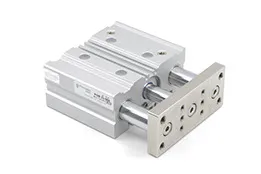
Guided cylinders
Guide rods integrated into the body resist side load and rotation. The load is carried directly on the mounting plate.
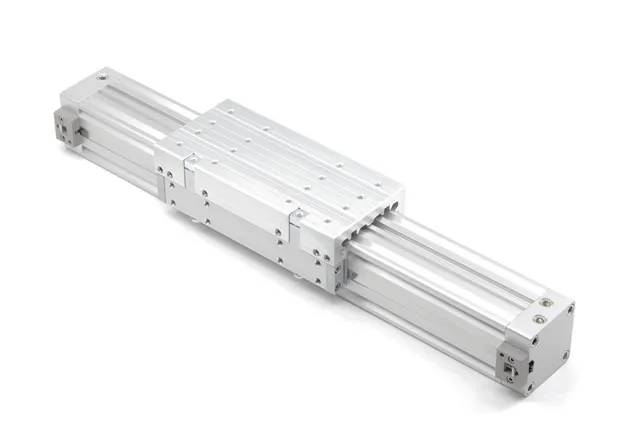
Rodless cylinders
The rod does not extend. A carriage moves along the body. A long stroke fits into half the length needed for the same stroke.
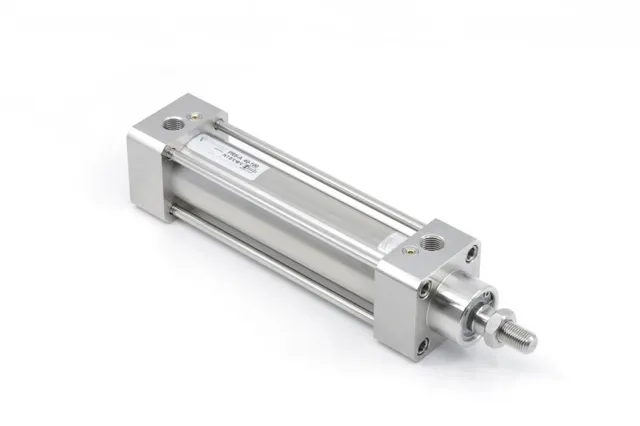
Stainless steel cylinders
Body, end caps and rod are stainless steel. Used in food, pharmaceutical and washdown environments, outdoors and in corrosive atmospheres.
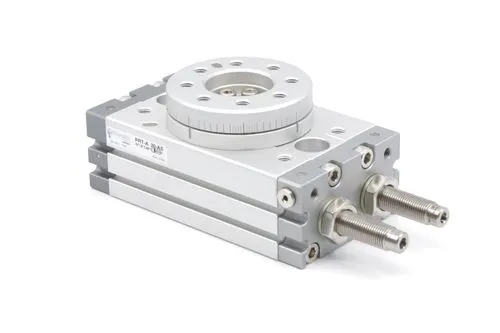
Rotary actuators
Rack and pinion or vane design that produces rotary motion over a limited angle (for example 90° or 180°).
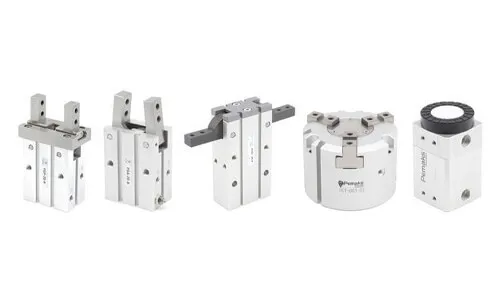
Grippers
Parallel or angular jaw components that grip and release the part. Used in assembly and handling automation.
Product images: Pemaks.
How to select
Selection starts with the type of motion: linear, rotary or gripping? For linear motion, a standard cylinder is enough when the load is only pushed. If the load acts from the side or the part must not rotate, a guided cylinder is the right choice, and if a long stroke does not fit into a tight space, a rodless cylinder is. If your application exceeds the force limit of pneumatics, we put both options side by side and compare them, because we also manufacture hydraulic cylinders.
Each of these types can be single acting or double acting. A single acting cylinder is driven by air in one direction and returned by a spring. It is used where the cylinder must return to its start position by itself when the air is cut off. A double acting cylinder is driven by air in both directions and delivers force in both directions. It is the most common type in industry.
Bore size is selected from the force. The table gives the force of each bore at 6 bar: a 50 mm cylinder produces 1,180 N extending and 990 N retracting. A margin is left for seal friction and for mains pressure that drops during the day. The practical rule is to choose a bore that gives at least 1.5 times the required force. Stroke cannot be selected independently of bore: on a slim cylinder with a long stroke the rod buckles under load. In such cases we increase the bore or recommend an external guide.
For a cylinder that will work in automation, a magnetic piston must be specified from the start: the end positions are reported to the controller by a cylinder sensor, and the magnet cannot be added later. On a cylinder running at high speed, adjustable cushioning protects the end cap and the rod bearing from impact. With ISO standard cylinders we can usually fit a direct replacement for the cylinder on an old machine. For non-standard types we find an equivalent by comparing the dimensions one by one.
A leaking cylinder usually does not need to be replaced completely: our service team rebuilds cylinders that return to their original performance with a new seal kit. If the body, rod or tube is damaged, we recommend a new cylinder.
Force of ISO cylinders at 6 bar
| Bore (mm) | Standard | Rod diameter (mm) | Extend force (N) | Retract force (N) |
|---|---|---|---|---|
| 25 | ISO 6432 | 10 | 295 | 245 |
| 32 | ISO 15552 | 12 | 485 | 415 |
| 40 | ISO 15552 | 16 | 755 | 635 |
| 50 | ISO 15552 | 20 | 1,180 | 990 |
| 63 | ISO 15552 | 20 | 1,870 | 1,680 |
| 80 | ISO 15552 | 25 | 3,015 | 2,720 |
| 100 | ISO 15552 | 25 | 4,710 | 4,420 |
Force = pressure × piston area. On the retract stroke the rod cross-section is subtracted from the area, so the force is always lower. Values are for 6 bar mains pressure; at 7 bar they are about 17% higher. In practice seal friction takes away a further 3–10%, so allow a margin when selecting.
Frequently asked questions
How much force does a 50 mm bore pneumatic cylinder produce?
At 6 bar, about 1,180 N extending and 990 N retracting. In kilogram-force that is roughly 120 kg and 101 kg. These are theoretical values. Because of seal friction, 3-10% less is obtained in the field.
Should I choose hydraulic or pneumatic?
Hydraulic if the force requirement is high and the position must be held precisely. Pneumatic for fast, repetitive and relatively light movements. A hydraulic cylinder of the same bore delivers dozens of times the force of a 6 bar pneumatic cylinder, because the system pressure is in the order of 150-250 bar.
What is the difference between ISO 15552 and ISO 6432?
ISO 15552 (formerly ISO 6431) defines profile body cylinders with bores of 32 mm and above. ISO 6432 is the standard for mini cylinders from 8 to 25 mm. Their mounting dimensions are different and they are not interchangeable.
What is a magnetic piston cylinder and when do I need one?
It is a cylinder with a permanent magnet embedded in the piston. A reed or PNP sensor mounted on the body detects this magnet and reports to the controller that the piston is at its end position. It is required for sequence control in automation and cannot be added later: the cylinder must be bought with a magnetic piston from the start.
What determines the speed of a pneumatic cylinder?
Flow rate, that is the amount of air passing per unit of time. Speed is not set by the cylinder itself but by the flow capacity of the valve and fitting and by the tubing diameter and length. On a slow cylinder, the tubing cross-section and valve size are checked first. Increasing the bore is usually the wrong fix.
Can the seals of a cylinder be replaced, or do I have to buy a new cylinder?
If the body and rod are sound, the cylinder is recovered by replacing the seal kit. Most leaks are caused by the seals. If the rod is scored or the bore is worn, new seals will leak again in a short time, and in that case complete replacement is more economical.
Can you find an equivalent for the cylinder on my old machine?
Yes. Sending a photo of the label on the cylinder or of its mounting dimensions is enough. With ISO standard cylinders we usually find a direct replacement. With non-standard cylinders we compare the dimensions and recommend the one that fits.
Can you build the circuit together with the cylinder?
Yes. We select the circuit of cylinder, valve, air preparation unit, tubing and fittings together and, where needed, design the pneumatic circuit of your machine from scratch. We do the same work on the machines we design ourselves.
Stock, sizes and part numbers
Sizes in stock, manufacturer part numbers and brands are kept up to date in our catalog. Send us your requirement on WhatsApp or by e-mail and we will quote and ship worldwide.