
Hydraulic ball valves
Two-way and three-way ball valves for high pressure hydraulic lines; threaded, flanged and panel mount types. For construction machinery, tipper trucks, tankers and cranes.
A ball valve is a simple and robust way to isolate a high pressure hydraulic line or divert oil between two circuits; its full bore design does not restrict the flow. On our own hydraulic power units and on truck mounted hydraulic systems we select the valve for the line pressure and connection. We ship hydraulic ball valves from stock across Türkiye and abroad, and also sell them through hidroticaret.com, our online store (Turkish).
Types
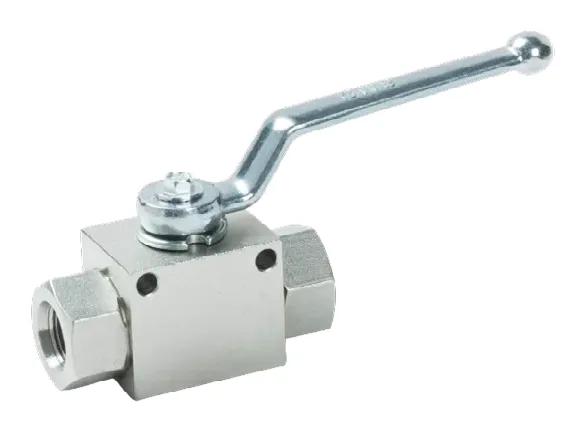
Two-way hydraulic ball valves
Opens and closes the line; used to isolate part of the circuit during maintenance and to isolate the accumulator.
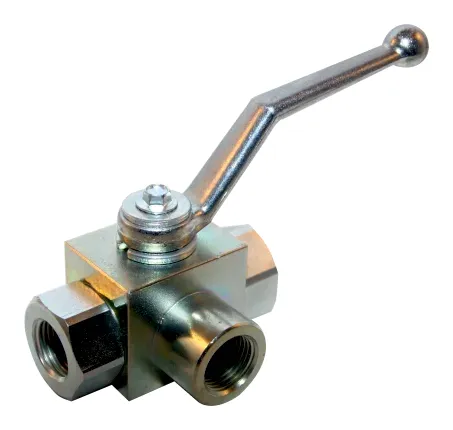
Three-way hydraulic ball valves
Diverts oil between two lines; L-port and T-port types. For tipper trucks, tankers and machines with two attachments.
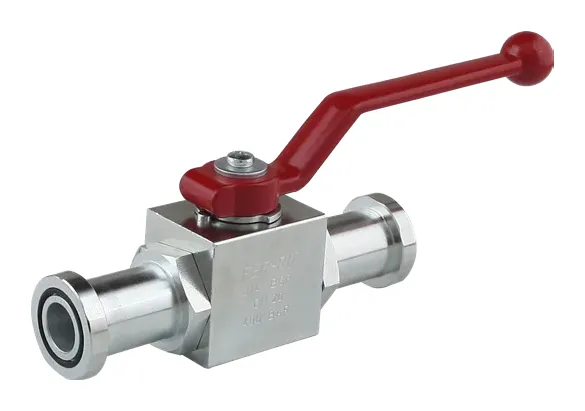
Flanged hydraulic ball valves
SAE flange connection for large size, high pressure lines.
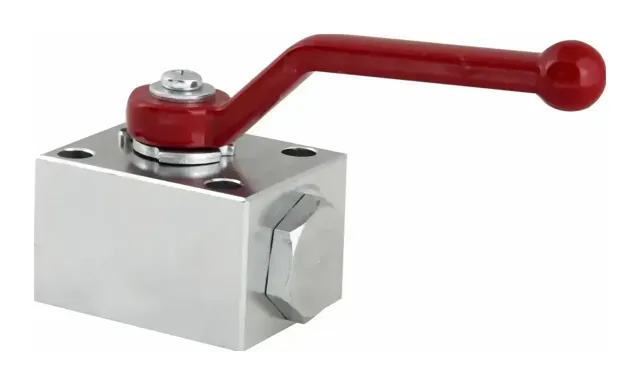
Panel mount valves
Valves with the body fixed to the panel and the handle outside it; for control panels.
Product images: hidroticaret.com and manufacturers.
How to select
Unlike water and gas valves, a hydraulic ball valve is built for high pressure: the body, ball and seals carry the pressure and shock of the hydraulic line. A plumbing valve must not be used on a hydraulic line.
In a three-way valve the port pattern determines which lines the valve connects. An L-port valve directs the inlet to one of two outlets; a T-port valve can connect all three lines together. The table below compares the two types.
A ball valve is an on/off device and is not left half open to throttle flow: a half open ball wears the seats. Where flow adjustment is needed, a flow control valve is used.
L-port and T-port patterns in three-way ball valves
| Port pattern | What it does | Typical use |
|---|---|---|
| L-port | Connects the inlet to one of two outlets; never connects all three ports at once | Selecting between two circuits: tipper or attachment |
| T-port | Connects two or three ports depending on position | Splitting or combining flow, mixing lines |
Which ports are connected in which position is checked from the marking on the body or the manufacturer's diagram.
Frequently asked questions
Can a water valve be used on a hydraulic line?
No. A hydraulic ball valve is built for high pressure and shock; a plumbing valve is not safe at hydraulic pressure.
What is the difference between L-port and T-port valves?
An L-port valve directs the inlet to one of two outlets; a T-port valve can also connect all three ports together, depending on position.
Can a ball valve be used for flow control?
No. A ball left half open wears the seats; a flow control valve is used for flow adjustment.
Which valve is used for a tipper truck?
Most tipper circuits use a three-way valve that diverts oil between the tipper and the other equipment; selection depends on the circuit.
What information do I need to provide?
Connection size and thread type, working pressure, two-way or three-way, and mounting type.
Which pressure rating should I choose for hydraulics?
The rated pressure of the valve must be above the peak pressure of the system; looking at working pressure alone is not enough. Pressure spikes in hydraulic circuits can rise well above the working value, so a margin is allowed.
Stock, sizes and part numbers
Sizes in stock, manufacturer part numbers and brands are kept up to date in our catalog. Send us your requirement on WhatsApp or by e-mail and we will quote and ship worldwide.
Hydraulic ball valves in the catalog Online store (Turkish) →