
Service, maintenance and hose crimping
Periodic and predictive maintenance that prevents unplanned downtime; repair and overhaul on site and in the workshop; on-site hydraulic hose crimping with a mobile service vehicle.
Service process
- 1
Report
Report the fault and the machine by WhatsApp, phone or e-mail; a photo and a video make the preliminary diagnosis easier.
- 2
Preliminary diagnosis
From the symptom and, where needed, from vibration, oil and leak measurements, we identify the probable cause and the part required, and decide whether the job will be solved on site or in the workshop.
- 3
Intervention
Our service team carries out the repair on site or in the workshop; if a hose is needed, it is crimped on site.
- 4
Test
The machine is run; pressure, speed and sealing are checked.
- 5
Record and follow-up
The work done is recorded and the time of the next maintenance is planned.
Product traceability tag
Every hose assembly we crimp is delivered with a traceability tag. The record holds the hose type, diameter, length, the fittings at both ends, the delivery date and a photo of the assembly. When the hose bursts or its replacement is due, you do not need to take measurements from the machine: it is enough to send us the code on the tag on WhatsApp, and we prepare the same assembly from the record. Our service team identifies a returned assembly from its tag and sees from the record what it is and when it was delivered. The record also contains a recommended inspection schedule; this is not a service life measurement but a reminder for planned replacement.
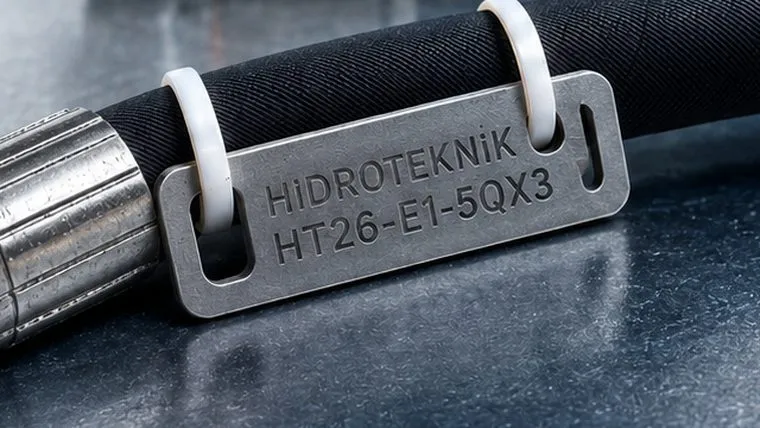
The tag is attached to the product with a clamp; the code is on the bottom line.
From the field
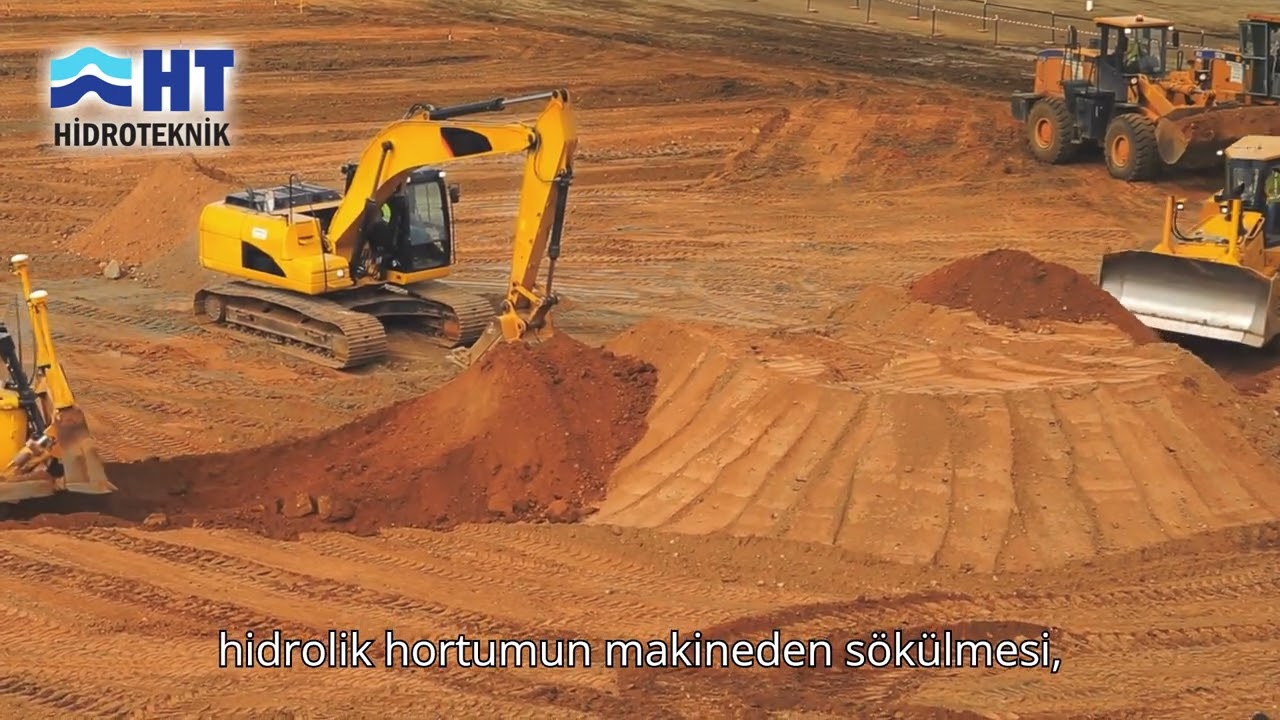
On-site service
Our service team responds to the breakdown on site: fault finding without dismantling and transporting the machine, hose and fitting replacement, seal renewal, pressure and speed adjustment. Urgent jobs are done in-house, by our own team; because our parts stock is at our company headquarters in Denizli, the waiting time does not depend on procurement.
Mobile hose crimping
With our service vehicle, which carries a crimping machine, we cut the hose to length at the breakdown site, crimp its fittings and install it. The construction machine, press line or vehicle-mounted equipment is back in operation where it stands; the time lost going to and from a workshop for a hose disappears. In our workshop we produce hose assemblies in series and carry out piping installation. Besides hydraulic hoses, industrial hoses such as food, chemical and concrete hoses are also in stock.
Predictive maintenance: seeing the fault before it happens
Our aim is not to wait for the machine to fail and stop, but to keep production running without unplanned downtime. In hydraulic and pneumatic systems most faults do not appear suddenly: pump wear shows itself in vibration, seal and valve leakage in heating, filter and oil degradation in the contamination level, weeks in advance. With our predictive maintenance instruments we measure these symptoms, compare the values with earlier measurements and time the intervention to coincide with a planned stop of the machine.
What we measure
- Vibration monitoring: vibration measurement on the pump, motor and coupling. The rise of the value over time reveals bearing wear, coupling misalignment and internal pump wear before failure.
- Air leak detection: locating leak points on compressed air lines by the ultrasonic method. A leak means the compressor is running for nothing; the points found are tagged and reported.
- Oil viscosity analysis: when the viscosity of the oil deviates noticeably from its nominal value (e.g. ISO VG 46), the oil has either degraded or been mixed with the wrong oil; this directly shortens pump and seal life.
- Oil contamination analysis: measuring the solid particle and water content of the oil. The contamination level is expressed with the ISO 4406 cleanliness code and compared with the limit the system requires (systems with proportional and servo valves need cleaner oil).
- Temperature and pressure check: deviation from normal operating values indicates internal leakage and loss of efficiency.
Oil flushing (system flushing) and oil change
In a contaminated system, changing the oil alone is not enough: the particles left in the pipes, the hoses and the bottom of the tank contaminate the new oil to the same level in a short time. In flushing, the system is flushed at high flow, with turbulent flow, by an external circulation unit with fine filters; once measurement confirms that the target cleanliness level has been reached, the new oil is filled through a filter. The same flushing is applied to newly built and overhauled systems before commissioning, so that swarf and weld residue left from assembly do not reach the pump at first start. In an oil change, the filter elements, the breather filter and tank cleaning are part of the same job.
Periodic maintenance and service records
Waiting for the breakdown is the most expensive maintenance method. We draw up a maintenance plan according to the operating conditions of the machine and record every visit in our service management system: the work done, the parts replaced, the values measured. The time of the next maintenance is planned from this record; a fault that recurs on the same machine also becomes visible this way. We follow up the maintenance of the cylinders and power units we manufacture in the same way.
What is checked in periodic maintenance
- Oil level, color and contamination; oil and filter change when needed
- Clogging indicators of the suction, pressure and return filters
- Outer surface of the hoses, fitting connections and traces of leakage
- On cylinders: rod surface, wiper seal and internal leakage
- Operating pressure, relief valve setting and speed values
- Accumulator pre-charge pressure, oil temperature and cooler
- Pump and motor noise, vibration, coupling and fasteners
Hose service life
Even if a hydraulic hose looks sound from the outside, its inner layer ages over time. According to the DIN 20066 recommendation, the service life of a hose assembly, including storage, should not exceed six years. A hose showing crushing, abrasion marks, cracks at the fitting, bulging or sweating is replaced without waiting for that period. The burst of a hose under pressure can cause an occupational accident; that is why we treat hose replacement as part of the maintenance plan.
Workshop repair and overhaul
- Hydraulic cylinder overhaul: seal replacement, rod and tube inspection
- Overhaul of power units, presses and lift systems
- Maintenance and repair of hydraulic and pneumatic machine lines
- Manufacturing of the required parts in our turning workshop
When reporting a fault
Please send the type of machine, the symptom of the fault and, if possible, a photo or a short video. For a hose replacement, the code on the label of the old hose and its length speed up our work.
Our other services
Hydraulic cylinder manufacturing
Design and manufacturing of custom hydraulic cylinders, to ISO standards or to the values of your project.
View →Hydraulic power unit (HPU) manufacturing
Compact and industrial hydraulic power units built for your machine: design, assembly and testing.
View →Machine and system design
We design the machine you need from scratch: from defining the requirement to 3D design, from calculation to manufacturing and series production.
View →Technical training
Hydraulics, pneumatics and sealing training with manufacturers, in our own training room and in the halls of our partner institutions (Denizli Chamber of Industry, Chamber of Mechanical Engineers, Denizli Organized Industrial Zone); technical training tailored to companies.
View →