
Pressure gauges and vacuum gauges
Bourdon tube, glycerine filled, diaphragm, electric contact and digital pressure gauges, vacuum gauges and compound gauges: dial sizes from Ø40 to Ø100, ranges from 0-1 bar to 0-600 bar.
The pressure gauge is the first component that shows the health of a hydraulic or pneumatic system. As a Pakkens dealer we stock dry and glycerine filled pressure gauges with Ø40, Ø63 and Ø100 dials. Every hydraulic power unit we build is fitted with a glycerine filled gauge as standard, and the unit is tested by reading that gauge.
Types
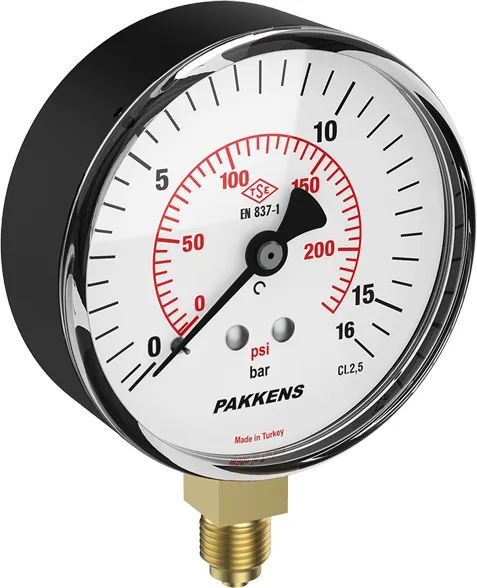
Bourdon tube pressure gauges
The general purpose type: a curved tube that tries to straighten under pressure turns the pointer. Used on air, water and oil lines at medium and high pressure.
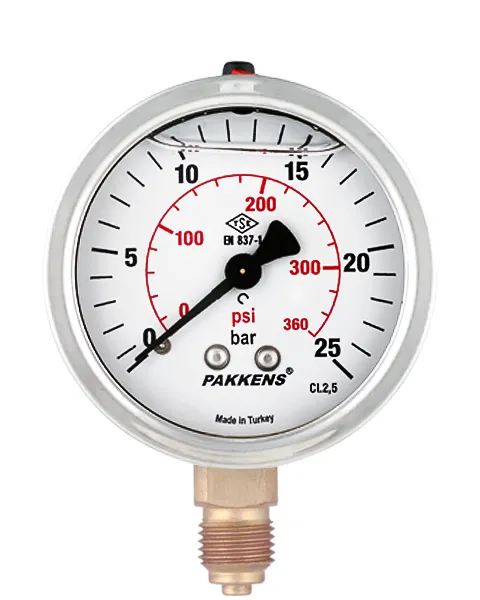
Glycerine filled pressure gauges
The case is filled with glycerine, which damps vibration and pressure spikes and stops the pointer from fluttering. This is the right choice at the pump outlet and in mobile hydraulics.
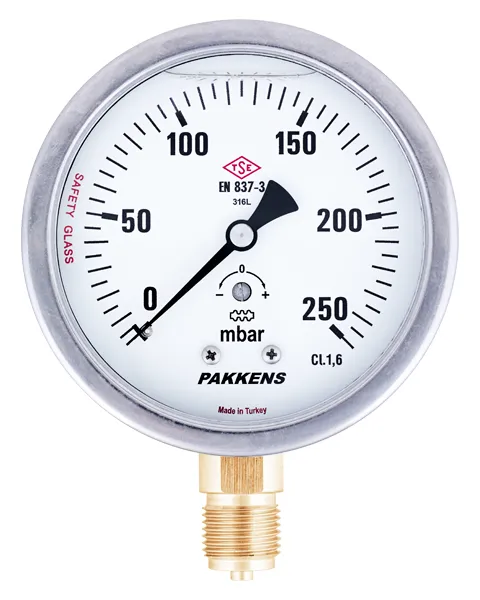
Diaphragm pressure gauges
The measuring element is a flexible diaphragm. Used for low pressures in the mbar range and for fluids that are abrasive or tend to clog.
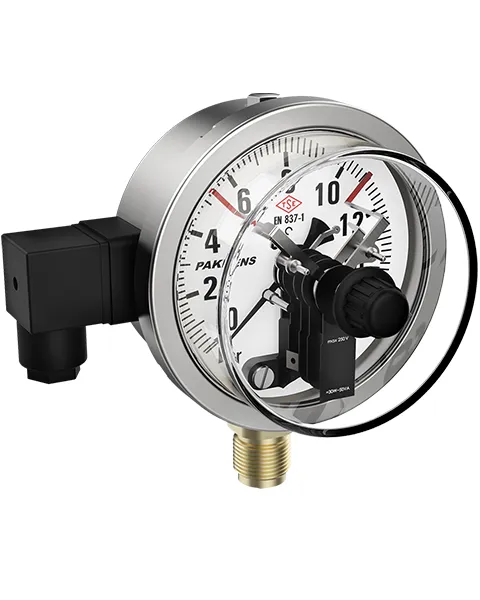
Electric contact pressure gauges
Give an electrical contact at the set pressure: they stop the pump, start the compressor or trigger an alarm. They control as well as measure.
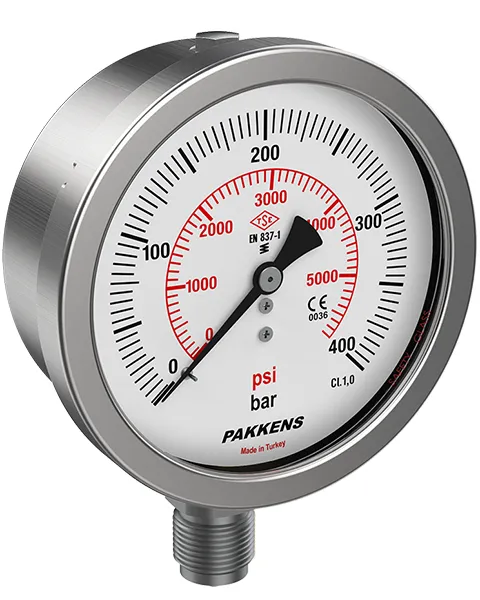
Stainless steel pressure gauges
The case and the connection are stainless steel; used in food, chemical and outdoor applications and in corrosive atmospheres.
Vacuum gauges and compound gauges
Measure below atmospheric pressure (-1…0 bar); a compound gauge shows both vacuum and positive pressure on the same dial. Used on vacuum lines and on the suction side.
Digital pressure gauges
Show the value numerically and can record the maximum and minimum values; used as a measuring instrument for testing, commissioning and troubleshooting.
Product images: Pakkens.
How to select
The range is selected according to the working pressure of the system: the pointer should not go beyond three quarters of the scale at steady pressure, or two thirds at fluctuating pressure. A smaller range fatigues the gauge and it soon starts to read incorrectly; a range that is too large reduces reading accuracy. The table below gives this rule in calculated form.
The case is selected according to the environment. A glycerine filled case is used where there is vibration and shock, a stainless steel case in corrosive environments, and the diaphragm type for low pressure and difficult fluids. With steam and hot fluids the gauge is not connected directly to the line; a syphon is fitted in between.
The connection position (bottom or back), the thread size and the dial diameter are determined by the panel and the reading distance: a panel mounted gauge uses a back connection, a gauge on the line uses a bottom connection, and a large dial is preferred where the gauge is read from a distance.
It is enough to tell us the working pressure, the connection thread and the environment; we recommend a suitable gauge from stock or one supplied from Pakkens.
Pressure gauge range by working pressure
| Working pressure | Smallest range at steady pressure | Smallest range at fluctuating pressure |
|---|---|---|
| 4 bar | 0-6 bar | 0-6 bar |
| 10 bar | 0-16 bar | 0-16 bar |
| 45 bar | 0-60 bar | 0-100 bar |
| 100 bar | 0-160 bar | 0-160 bar |
| 110 bar | 0-160 bar | 0-250 bar |
| 160 bar | 0-250 bar | 0-250 bar |
| 180 bar | 0-250 bar | 0-400 bar |
| 200 bar | 0-400 bar | 0-400 bar |
| 350 bar | 0-600 bar | 0-600 bar |
Calculation: the pointer should not go beyond 3/4 of the scale at steady pressure or 2/3 at fluctuating pressure (EN 837-2 recommendation); ranges are taken from the EN 837-1 standard series (1; 1.6; 2.5; 4; 6 and their multiples of 10).
Frequently asked questions
What pressure gauge range do I need for a 200 bar system?
If the pressure is steady, the pointer should not go beyond 3/4 of the scale; on a 0-250 bar gauge, 200 bar is above that limit. The right choice is 0-400 bar.
What is a glycerine filled pressure gauge used for?
The glycerine damps the pointer mechanism against vibration and pressure spikes; the pointer does not flutter, reading is easier and the gauge lasts longer.
Why does my pressure gauge not return to zero?
The Bourdon tube may have seen pressure above the scale or been fatigued by pressure spikes. In that case the gauge no longer gives a reliable reading and should be replaced; the next higher range should be selected.
Which pressure gauge do you use on your power units?
A glycerine filled pressure gauge is standard equipment on the hydraulic power units we build; before delivery the unit is tested by reading this gauge.
How can I tell if a Pakkens product is genuine?
You can check the product on the Pakkens product verification page.
Bottom connection or back connection?
A bottom connection is used if the gauge is fitted directly on the pipe or stands on the machine; a back connection is used if it is flush mounted in a panel and read from the front. There is no difference in measurement, only the mounting direction changes.
When is a diaphragm pressure gauge needed?
When the pressure to be measured is in the mbar range, or when the fluid is sticky, crystallising or abrasive. The diaphragm type is used in ventilation ducts, filter clogging monitoring, low pressure process lines and food lines.
Stock, sizes and part numbers
Sizes in stock, manufacturer part numbers and brands are kept up to date in our catalog. Send us your requirement on WhatsApp or by e-mail and we will quote and ship worldwide.
Pressure gauges and vacuum gauges in the catalog Online store (Turkish) →