
Gauge isolator valves and pressure test equipment
Gauge isolator valves, push button gauge isolators, syphons, snubbers, test point couplings and test hoses: the accessories that connect a pressure gauge to the line safely.
A pressure gauge usually fails because of its connection, not because of the gauge itself: pressure spikes, vibration or hot fluid wear it out quickly. This is why on our power units we do not connect the gauge directly to the line, but through accessories that protect it.
Types
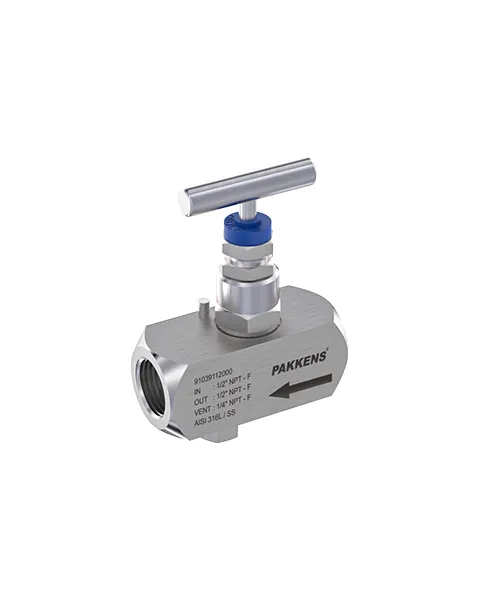
Gauge isolator valves
Needle valve types isolate the gauge from the line; the gauge can be removed and replaced without stopping the system.
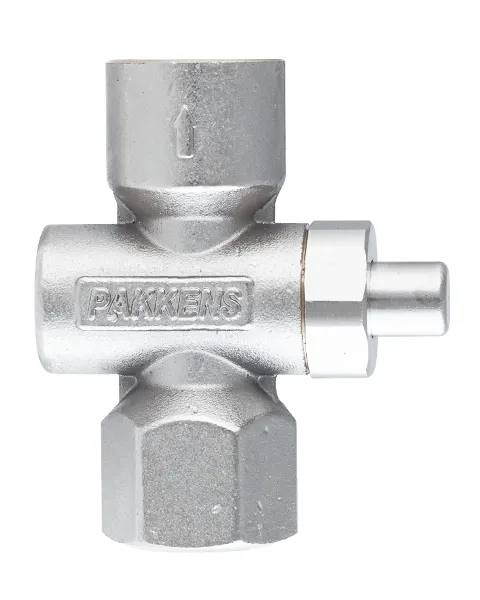
Push button gauge isolators
When the button is pressed the gauge sees pressure, when it is released the gauge is isolated. Because the gauge is not under pressure all the time, it lasts longer.
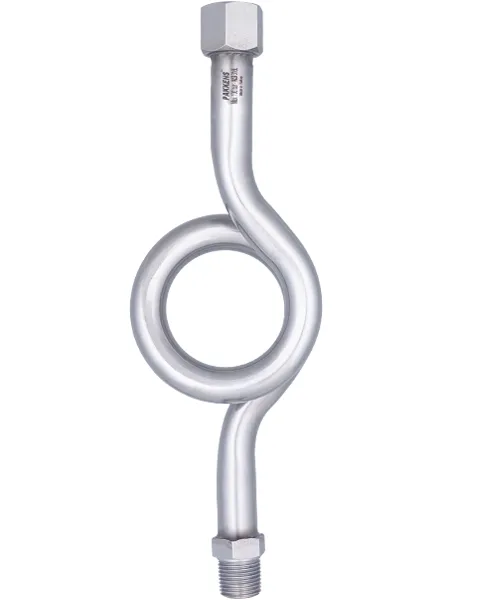
Syphons
On steam and hot fluids they protect the gauge from temperature by putting condensate between the gauge and the line.
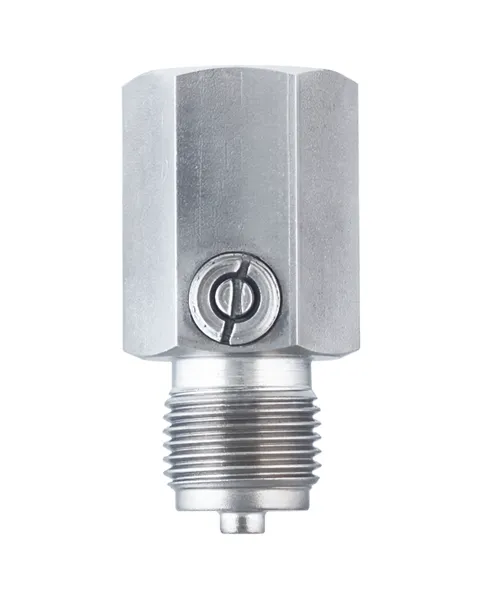
Pressure gauge snubbers
The restriction in the connection softens the pressure spike before it reaches the gauge.
Test point couplings and test hoses
Test couplings fitted permanently at different points of the circuit; with a gauge connected through a test hose, pressure is measured while the system is running, without opening it.
Product images: Pakkens.
How to select
The gauge accessories determine how quickly the pressure gauge wears out. A snubber or a push button isolator is used at points with pressure spikes such as the pump outlet, a syphon on steam and hot fluids, and a gauge isolator valve where the gauge has to be replaced often.
Test point couplings save time in maintenance and troubleshooting: they make it possible to measure at which point of the circuit the pressure drops, without opening the system and without losing oil. Including these points in the circuit when designing a new unit is much easier than adding them later.
Pressure unit conversion
| bar | psi | MPa | kgf/cm² |
|---|---|---|---|
| 1 bar | 15 psi | 0.1 MPa | 1.0 kgf/cm² |
| 10 bar | 145 psi | 1.0 MPa | 10.2 kgf/cm² |
| 100 bar | 1,450 psi | 10.0 MPa | 102.0 kgf/cm² |
| 160 bar | 2,321 psi | 16.0 MPa | 163.2 kgf/cm² |
| 250 bar | 3,626 psi | 25.0 MPa | 254.9 kgf/cm² |
| 400 bar | 5,802 psi | 40.0 MPa | 407.9 kgf/cm² |
Calculation: 1 bar = 14.5038 psi = 0.1 MPa = 1.01972 kgf/cm². On most imported pressure gauges and transmitters the dial or the label is marked in psi.
Frequently asked questions
What is a push button gauge isolator used for?
The gauge sees pressure only when the button is pressed; the rest of the time it is protected from pressure spikes and vibration, and it lasts longer.
Why is a test point coupling needed?
It makes it possible to measure the pressure at different points of the circuit without opening the system and while it is running; it speeds up troubleshooting.
When is a pressure gauge syphon used?
On steam and hot fluid lines, to protect the pressure gauge from high temperature.
How do I remove a pressure gauge from the line?
If there is a gauge isolator valve or a push button isolator, the valve is closed and the gauge is removed without stopping the system. If there is no such accessory, the system has to be stopped and the pressure fully released.
Where should test point couplings be fitted?
At the pump outlet, at the valve manifold inlet and close to the cylinder or hydraulic motor connections. In troubleshooting, the point where the pressure drops is then found without opening the system.
My imported pressure gauge reads in psi, how do I convert psi to bar?
1 bar is about 14.5 psi. The conversions in the table give the most commonly used values.
Stock, sizes and part numbers
Sizes in stock, manufacturer part numbers and brands are kept up to date in our catalog. Send us your requirement on WhatsApp or by e-mail and we will quote and ship worldwide.
Gauge isolator valves and pressure test equipment in the catalog Online store (Turkish) →