
Gas springs
Standard, lockable, refillable and adjustable, stainless steel (marine), traction type and hydropneumatic gas springs: components that support lids and doors, make lifting easier and damp movement.
What makes a heavy lid, machine guard or door open with one hand and stay open safely is a gas spring with the right force. The wrong force means a lid that either drops or opens by itself. We calculate the required force from the weight of the lid and the mounting geometry, and suggest a gas spring that suits the dimensions and the end fitting. We ship gas springs from stock to every part of Türkiye and abroad, and also sell them through our online store (Turkish) at hidroticaret.com.
Types
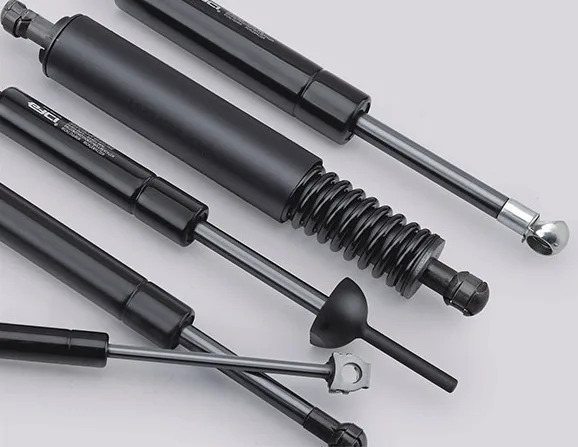
Standard gas springs
The basic type that supports lids, doors and guards and makes opening easier. For machinery, furniture and vehicle applications.
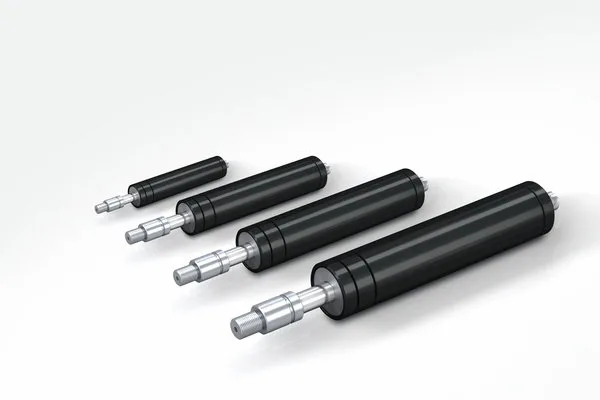
Lockable gas springs
A type with a mechanism that fixes the piston in the required position. For adjustable tables, seats and lids.
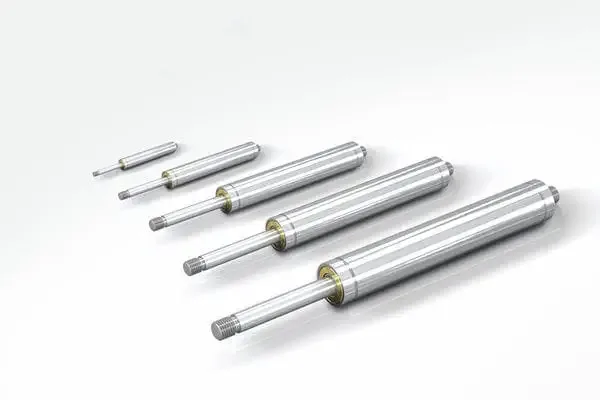
Stainless steel (marine) gas springs
A corrosion resistant stainless steel body. For marine, food and outdoor applications.
Refillable and adjustable gas springs
The gas pressure can be adjusted afterwards and the spring can be refilled. For machines with a variable load or at the prototype stage.
Traction gas springs (pull type)
They deliver their force by pulling the piston rod in. For mechanisms where the force is needed in the inward direction.
Hydropneumatic dampers
They use gas and hydraulic fluid together. For applications that need shock absorption and controlled damping.
How to select
The required force is found from the weight and geometry of the lid. If the weight of the lid, the distance of its center of gravity from the hinge and the lever arm at which the gas spring is mounted relative to the hinge are known, the approximate force follows from the moment balance. If two gas springs are used, the force is divided by two, and an allowance of about 10 percent is added for friction. If the force is too low the lid drops, and if it is too high the lid opens by itself and will not close. The table below gives this calculation for common values.
Length is defined by the compressed length and the stroke; the extended length is the sum of the two. Where possible, a gas spring is mounted with the rod pointing down: the oil inside lubricates the seal and damps the movement at the end of the stroke.
Gas pressure changes with temperature: the force decreases in the cold and increases in the heat. For a lid that works in a cold environment the force is therefore chosen slightly higher. The second table shows the approximate effect of temperature on force.
The force (N) and the dimensions are usually printed on the old gas spring, so sending us a photo of it is enough to find the same one. The end fittings (eyelet, clevis, ball joint) are also specified together with the dimensions.
Force per gas spring by lid weight (with two gas springs)
| Lid weight | Lever ratio 1.5 | Lever ratio 2 | Lever ratio 3 |
|---|---|---|---|
| 5 kg | 40 N | 54 N | 81 N |
| 10 kg | 81 N | 108 N | 162 N |
| 20 kg | 162 N | 216 N | 324 N |
| 30 kg | 243 N | 324 N | 486 N |
| 50 kg | 405 N | 540 N | 809 N |
Calculation: force = weight × g × lever ratio ÷ number of gas springs × 1.1 (friction allowance). The lever ratio is the distance of the lid's center of gravity from the hinge divided by the distance of the gas spring mounting point from the hinge. Because the geometry changes between the fully open and the closed position, the exact value is calculated from the mounting points.
Approximate effect of temperature on gas spring force
| Ambient temperature | Relative to the force at 20 °C |
|---|---|
| -20 °C | 86% |
| 0 °C | 93% |
| 20 °C | 100% |
| 40 °C | 107% |
| 60 °C | 114% |
Calculation: gas pressure is assumed to be proportional to absolute temperature (ideal gas). The actual value varies slightly with the oil quantity and construction of the gas spring.
Frequently asked questions
How do I calculate the force of a gas spring?
From the weight of the lid and the distances of the center of gravity and of the gas spring mounting point from the hinge. Just send us the weight and the two distances and we will do the calculation.
Which way up should a gas spring be mounted?
With the rod pointing down where possible. The oil inside lubricates the seal and provides damping at the end of the stroke.
Why does my lid open by itself?
The gas spring force is too high. A gas spring with a lower force is needed, or the mounting point has to be changed.
Why does my lid drop in winter?
Gas pressure falls in the cold and the force decreases. For a lid that works in a cold environment the force is chosen slightly higher. If the gas spring is old, it may also have lost gas.
Can you find the same gas spring as my old one?
Sending us a photo of the force (N) and dimension marking on it, or of the gas spring itself, is enough.
When do I need a stainless steel gas spring?
In places with a risk of corrosion, such as marine, food, chemical and outdoor environments.
Stock, sizes and part numbers
We select and supply the products in this group according to the application. Send us your requirement, the size and the operating conditions on WhatsApp and we will recommend the right product.